Reinforcement
Carbon fibres


Machines-3D Filament Carbon fiber + Nylon PA12 1,75mm 500g Black

Available on Click & Collect · Pay by card or cash at pickup, or choose bank transfer at checkout How does it work?
Carbon fibres
High rigidity
Jigs & fixtures
| Material | PA12 + carbon fibre |
|---|---|
| Manufacturing process | FDM / FFF |
| Filament diameter | 1.75 mm |
| Net filament weight | 500 g |
| Suggested extrusion temperature | 250–265 °C |
| Suggested bed temperature | 60–70 °C |
| Suggested printing speed | 40 mm/s |
| Nozzle material | Wear-resistant / hardened nozzle |
| Data interpretation | Typical manufacturer values. Printing settings depend on printer and plate; mechanical and HDT data are not guaranteed operating limits. |
Machines-3D
Build a test part before production and assess deflection, fastening and fit. Validate performance after the part reaches its expected operating humidity.
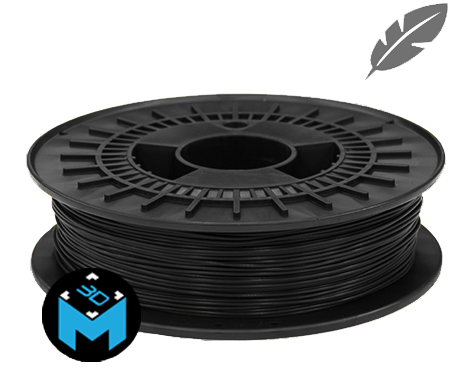
A nylon composite for technical parts where rigidity and functional performance matter.
Use it when developing jigs, fixtures and equipment accessories rather than purely visual models.
The black composite is suited to discreet, functional components and mechanical prototypes.
Build a test part before production and assess deflection, fastening and fit. Validate performance after the part reaches its expected operating humidity.
Store sealed with desiccant and use a suitable drying process before printing. Choose a wear-resistant nozzle and confirm the profile for this exact Machines-3D grade.
The supplier sheet gives 250–265 °C nozzle, 60–70 °C bed and 40 mm/s as reference settings. Adjust the profile to the printer, part and bed surface.
Use a wear-resistant nozzle for the fibre reinforcement. Keep nylon dry during storage and printing to maintain extrusion quality and reduce moisture-related defects.
Orient layers for the main load direction and validate wall thickness and infill on a sample. Supplier test data distinguishes specimen conditions; a printed composite remains direction-dependent.
1 spool of Machines-3D Nylon PA12 Carbon Fibre — 500 g, selected colour