Reinforcement
Carbon fibres


Kimya Filament ABS Carbon (ABS + Carbon fiber) 1,75mm 500g Black

Available on Click & Collect · Pay by card or cash at pickup, or choose bank transfer at checkout How does it work?
Carbon fibres
Tooling & fixtures
100°C
| Material | ABS + carbon fibre |
|---|---|
| Manufacturing process | FDM / FFF |
| Filament diameter | 1.75 mm |
| Net filament weight | 500 g |
| Density (ISO 1183-1) | 1.032 g/cm³ |
| Glass transition temperature (DSC) | 100 °C |
| Tensile strength (printed XY, ISO 527) | 37.4 MPa |
| Nozzle material | Wear-resistant / hardened nozzle |
| Data interpretation | Typical manufacturer values. Printing settings depend on printer and plate; mechanical and HDT data are not guaranteed operating limits. |
Kimya
Choose walls, infill and print orientation for the expected stresses. Carbon-filled filament is not equivalent to continuous-fibre reinforcement.
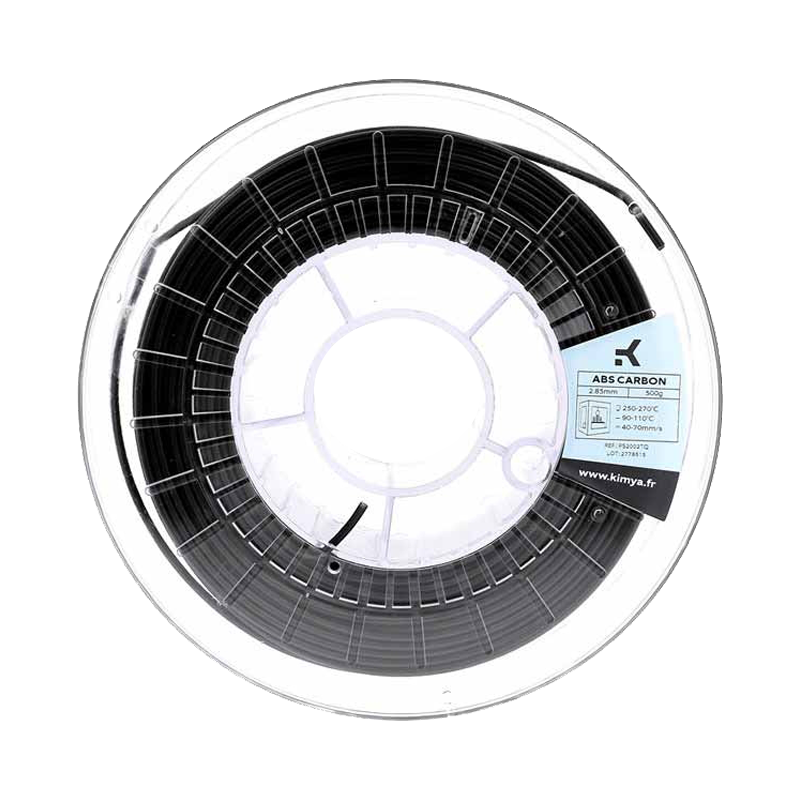
A composite combining ABS with carbon fibres for technical parts and workshop applications.
Consider the material for fixtures, functional prototypes and components where reinforced ABS is appropriate.
The black reinforced material provides a technical appearance suited to equipment parts.
Choose walls, infill and print orientation for the expected stresses. Carbon-filled filament is not equivalent to continuous-fibre reinforcement.
Use a wear-resistant nozzle and a stable ABS printing environment. Check the grade-specific Kimya profile before setting temperature or drying cycles.
Kimya highlights interlayer adhesion and reduced shrinkage alongside compression resistance. These properties support rigid fixtures and functional prototypes.
The technical sheet reports printed-specimen properties, with orientation and infill defined for each test. Use the technical table as a reference, then test your part in its intended load direction.
Carbon-filled material requires a wear-resistant nozzle. Control cooling and use an enclosed, ventilated printing setup to manage ABS shrinkage and emissions.
1 spool of Kimya ABS Carbon — 500 g, selected colour