


Connectivity
Wi-Fi + replaceable battery


EINSTAR Rockit Wireless 3D Scanner

Available on Click & Collect · Pay by card or cash at pickup, or choose bank transfer at checkout How does it work?
Wi-Fi + replaceable battery
Laser + IR VCSEL
425 g
| Light source | 38 crossed + 7 parallel blue laser lines; IR VCSEL |
|---|---|
| Point distance — Laser HD | 0.05–10 mm |
| Point distance — IR Rapid | 0.2–10 mm |
| Working distance — Laser HD | 100–600 mm |
| Working distance — IR Rapid | 160–1400 mm |
| Scanning speed — Laser HD | Up to 2,800,000 points/s |
| Scanning speed — IR Rapid | Up to 4,800,000 points/s |
| Weight | 425 g including battery / 353 g without battery |
| Dimensions | 130 × 37 × 61 mm |
| File formats | STL / OBJ / PLY / 3MF / ASC |
EINSTAR
A compact wireless laser and infrared scanner for object digitisation, reverse engineering and creative 3D work.

Marker-free laser tracking is intended for objects with sufficient geometric features. Featureless surfaces may still need markers. Marker-free laser capture is intended for objects with enough distinctive shape to maintain alignment. The manufacturer recommends at least 64 GB of system memory for this mode; featureless or repetitive shapes may need markers.

Built-in Wi-Fi and a replaceable battery support mobile capture. Processing uses a compatible computer running EXStar Hub.

38 crossed laser lines cover larger areas; 7 parallel lines capture finer features. IR VCSEL provides another mode for larger objects.
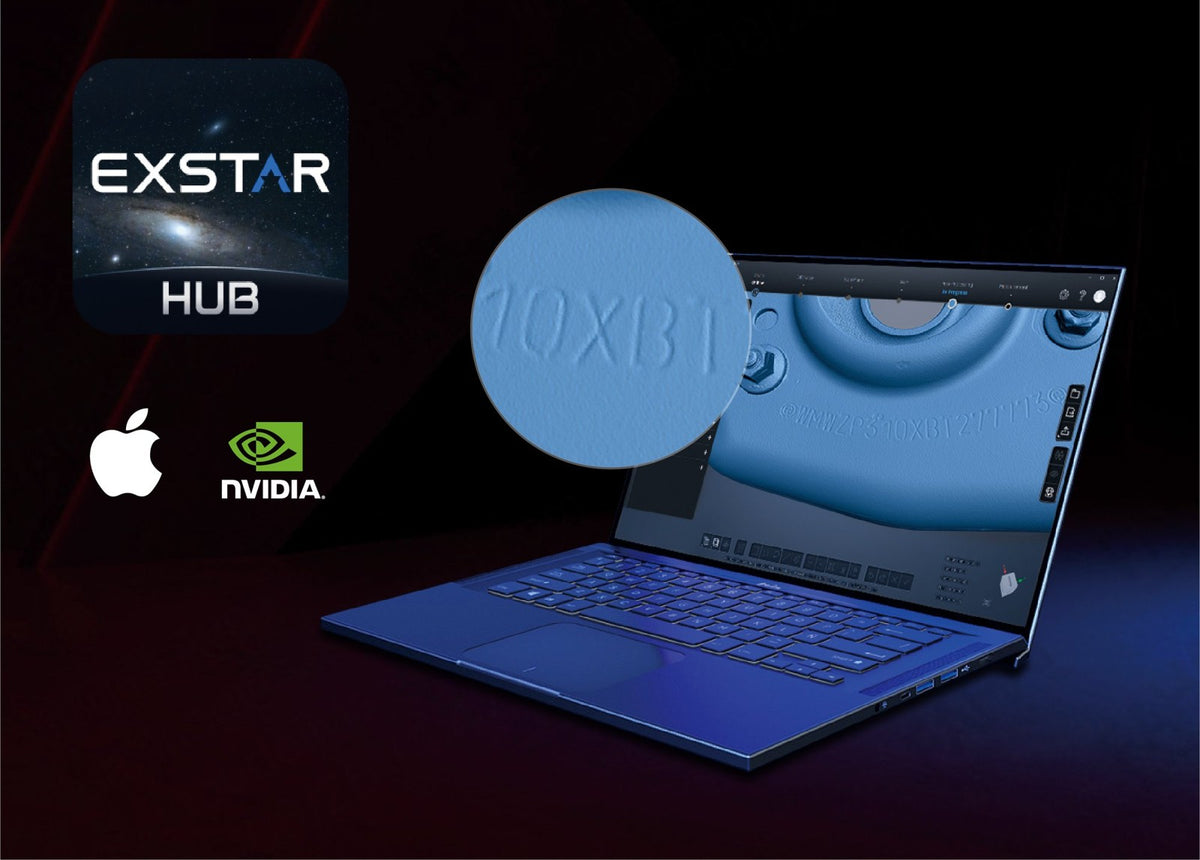
EXStar Hub brings calibration, scanning and processing into one interface for this scanner. Use the appropriate laser or infrared mode, monitor coverage and clean the resulting data before export.
Compatible EXModel Personal tools cover mesh editing, primitive extraction, 3D sketching, surface filling and constrained 2D sketches. Comparison tools help assess the reconstructed geometry against the scan; software access depends on the selected package.

Colour texture supports digital replicas, creative work and product visualisation. Geometry remains available for 3D printing and reverse engineering, while CAD reconstruction and dimensional inspection require their own downstream software and method.
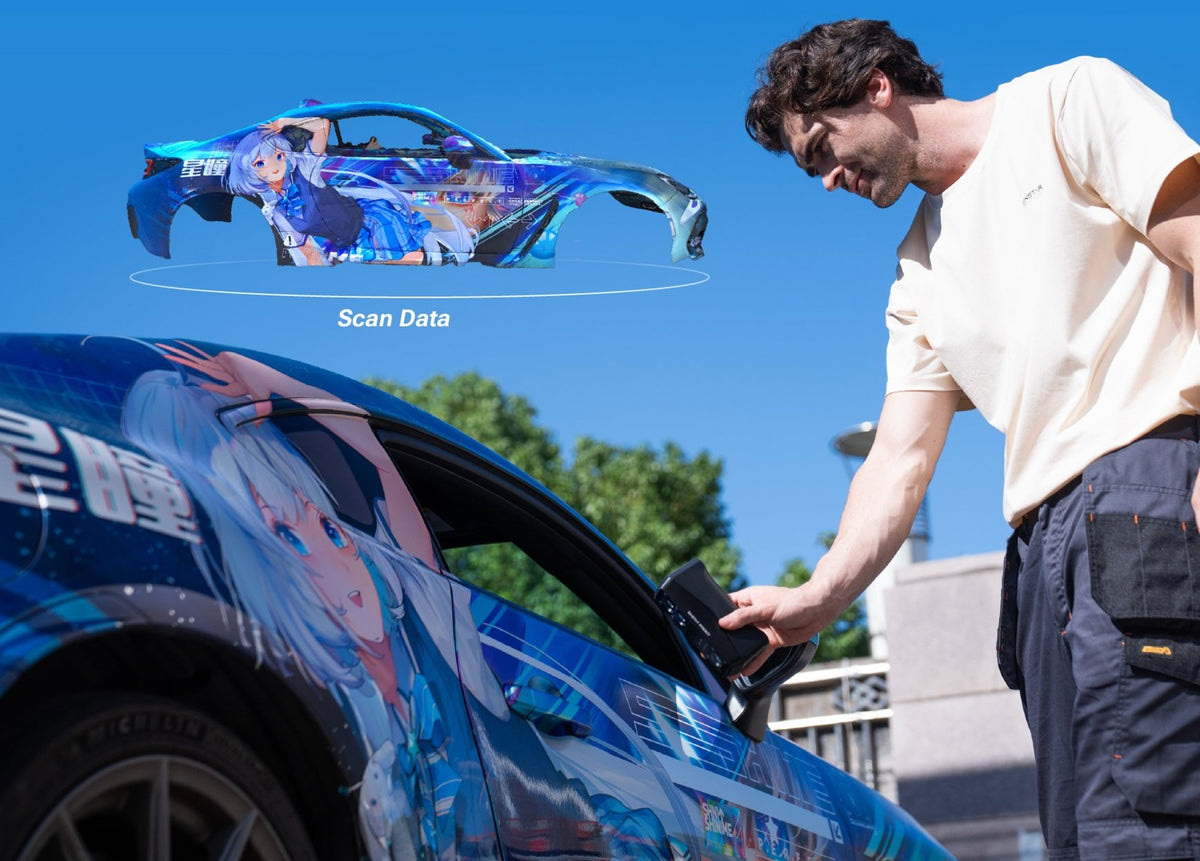
Built-in wireless connectivity reduces cables during acquisition. Outdoor-capable modes extend the working environment, but surface behaviour, available references and lighting still determine the best settings.