


Outdoor use
UV & weather resistance


Bambu Lab ASA 1 kg with Spool

Available on Click & Collect · Pay by card or cash at pickup, or choose bank transfer at checkout How does it work?
UV & weather resistance
100°C
Impact resistance
| Material | ASA |
|---|---|
| Manufacturing process | FDM / FFF |
| Filament diameter | 1.75 mm |
| Net filament weight | 1 kg |
| Nozzle temperature | 240–270 °C |
| Bed temperature (prepared plate) | 80–100 °C |
| Drying (forced-air oven) | 80 °C / 8 h |
| Printing speed (profile dependent) | < 250 mm/s |
| Density (ISO 1183) | 1.05 g/cm³ |
| HDT — ISO 75, 0.45 MPa | 100 °C |
| Storage humidity | < 20% RH — sealed with desiccant |
| Data interpretation | Typical manufacturer values. Printing settings depend on printer and plate; mechanical and HDT data are not guaranteed operating limits. |
Bambu Lab
Consider plant markers, instrument housings and outdoor equipment accessories. In UAE sunlight, assess surface temperature as well as air temperature.

ASA is intended for prolonged outdoor exposure, with greater resistance to sunlight-related fading and degradation than conventional ABS.

Use its impact resistance for signs, outdoor equipment accessories and protective housings.

The manufacturer reports an HDT of 100 °C at 0.45 MPa. Actual usable temperature depends on load, geometry and print conditions.
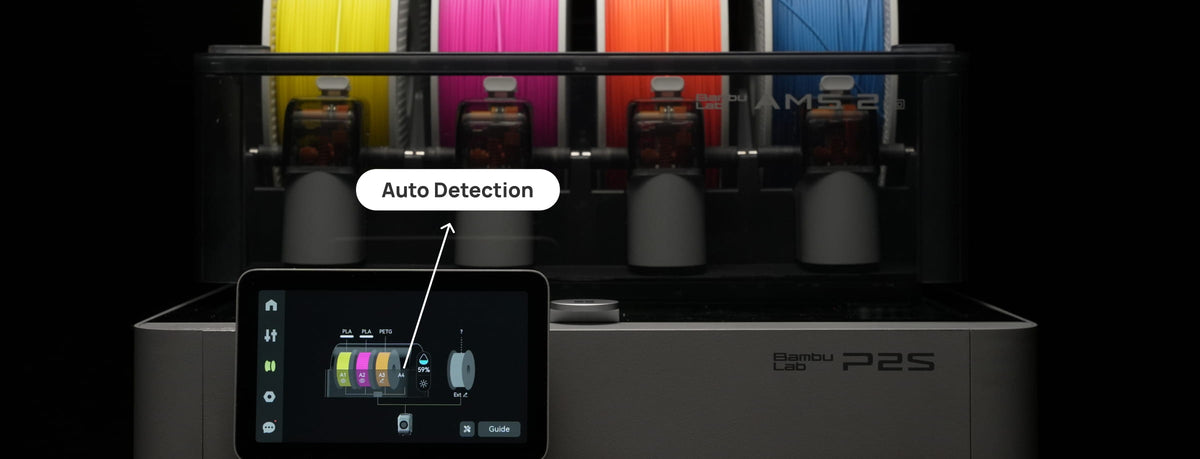
The spool RFID supplies material information to compatible Bambu AMS systems.
Use an enclosed printer. The supplier excludes Cool Plate SuperTack; select the ASA profile and a supported heated build plate.
Follow the drying values in the technical table and store sealed with desiccant. Keep the spool within its own temperature limit; printer-bed and forced-air-oven settings are not interchangeable.
Use an enclosed printer in a well-ventilated workspace. Large, dense models are more prone to lifting: prepare the plate, avoid drafts and adjust bed temperature and speed within the material profile.
1 spool of Bambu Lab ASA — 1 kg, selected colour